

How To Clean The Sticky Feeling Off Of My Rubber Framed Sunglasses?
7 to eight years back, CSS developers brought a fifth child into the positioning chemical element world. The proper noun of this chemical element was "sticky" because all it does is get 'stick' to the viewport and just be in your sight (depending on the developer though). Although the sticky belongings of an element gives a name to a particular holding in CSS, it does not bring anything 'new" to the tabular array. If I say, "let's use a sticky div box," yous know what I am talking about, but earlier its release people would just define what they wanted to do like "Tin I have a div box that would ever be visible or available even if the people are scrolling?"
The entire indicate of bringing this up is to tell yous that stickiness existed in web development long before it was introduced as a standard in CSS. This post will dive into the CSS position sticky, and we will find out how to get the CSS position fixed. Before nosotros do that, permit'southward briefly see how people used the position mucilaginous property before its official release.
Need For Position Sticky In CSS
As I mentioned, the position sticky in CSS was used even before it came out as a standard in CSS. So, why did they introduce information technology when everything was working fine?
Apart from CSS, the stickiness tin be achieved through JavaScript too. In JavaScript, we make the utilise of scroll event handlers and calculate the offset of the page. With these values, we make calculations to stick the chemical element as shortly as the offset reaches a point. This used to work earlier, but for the last eight-nine years, gyre handlers became a total mess when meliorate graphics were introduced in the systems.
The problem with coil handlers is that unlike CSS, it relies on the CPU for doing its job. On the other hand, CSS uses hardware acceleration (a standard on all the browsers at present for better cross browser compatibility), which means it relies on the GPU for doing its job. Due to this, we would frequently see the UI of the website, breaking down quickly when the sticky chemical element is coded in JavaScript. A amend solution to this is bringing the stickiness to the GPU. The only way to do that is by introducing it as a standard in CSS. Looking back, it actually makes a lot of sense. So, the "viscid" property was added to the positions which already had four values. To empathize how to go "CSS position stock-still," we should know the beliefs of other CSS values.
Read: Detailed Guide To CSS Supports In Browsers
CSS Position And Its Values
The position attribute in CSS is used to ascertain the position of the element used in the browser window. With CSS position fixed, y'all can manipulate how the element behaves using dissimilar values of this property. Before the value "sticky" came into the picture, CSS: Position had four dissimilar values:
Static: The element with a static value remains with the natural flow of the document. Specifying positions through the meridian, left, right, etc., will not affect this element. This is also the default beliefs of an chemical element in HTML.
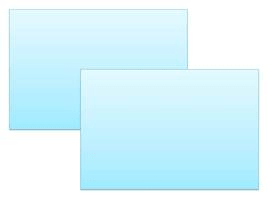
Relative: The relative value is the aforementioned every bit the static value but at present the left, right, top, bottom values will affect the position of the element. So, the position of the element will become relative to its default position and hence the give-and-take relative. Although, it is important to call back that moving this element will not bear upon other elements and they will still remain in their actual position and actual infinite. If z-index is non set properly, your two elements might overlap like this:
Accented: The absolute value of CSS: Position takes the chemical element out of the normal flow of the folio and searches for the closest parent (ancestor) which is bachelor with the position set up to either relative or absolute. When such an ancestor is institute, this element is moved relative to this antecedent by using left, right, tiptop, bottom specified values. If in that location is no such ancestor that has this property, the default antecedent will get an chemical element and this element volition be placed relative to < html > i.east. the web page itself.
Fixed: An chemical element with the fixed property is fixed with respect to the container block which most of the time is the browser's window likewise called the viewport. The benefit of having a fixed position gluey chemical element is that it does not motion even though yous scroll the window. The best example is the navigation bar, which is fixed past the developers at a unmarried place most of the fourth dimension. But, information technology should be noted that the container block is non always the viewport of the browser. The container element can change if whatever of the ancestors of the fixed element has a transformative, perspective, or filter property set to something else other than none. In such cases, this ancestor becomes the container cake, and the fixed chemical element's beliefs changes accordingly. When the block position is identified, the final position depends on the summit, left, right, bottom properties only. This is a slap-up mode to go your CSS position fixed.
The floating behaviour of fixed and accented often causes problems in designing the user interface unknowingly or when the programmer does non have prior knowledge. Since these elements are set relative to some other element in the HTML, they sometimes overlap other elements partially or fully and hide those elements. Actually, it is really impossible to note down the number of situations where you tin go wrong while designing a spider web folio. Every time, there is something different happening in the lawmaking. In the instance of CSS position sticky, the developer is frequently certain about the static and relative elements since they are always on the natural menses of the document and do not depend on other elements but fixed and absolute should exist used very carefully.
What is CSS Position Glutinous?
The fifth value of the CSS: Position that came after all of the values discussed above is the sticky value. A position viscous element toggles between the relative value and the fixed value on the viewport. The land on which the CSS sticky element is currently present depends on the scroll position of the browser window.
The position of the CSS sticky element depends upon the given offset or a threshold tiptop, bottom, left, and right value that the programmer provides. If the element has not nonetheless reached the threshold, information technology retains in the relative position. One time the threshold is reached, y'all've got the CSS position fixed and the elements get "stuck" to the same cake. This is not a one-fourth dimension performance though. The CSS position viscous chemical element toggles between these two positions depending on the scroll of the folio. So, a CSS position sticky element that is currently "fixed" volition move back to the "relative" when it will run into the contrary cease of its container cake.
The following GIF shows how a CSS position glutinous chemical element looks:
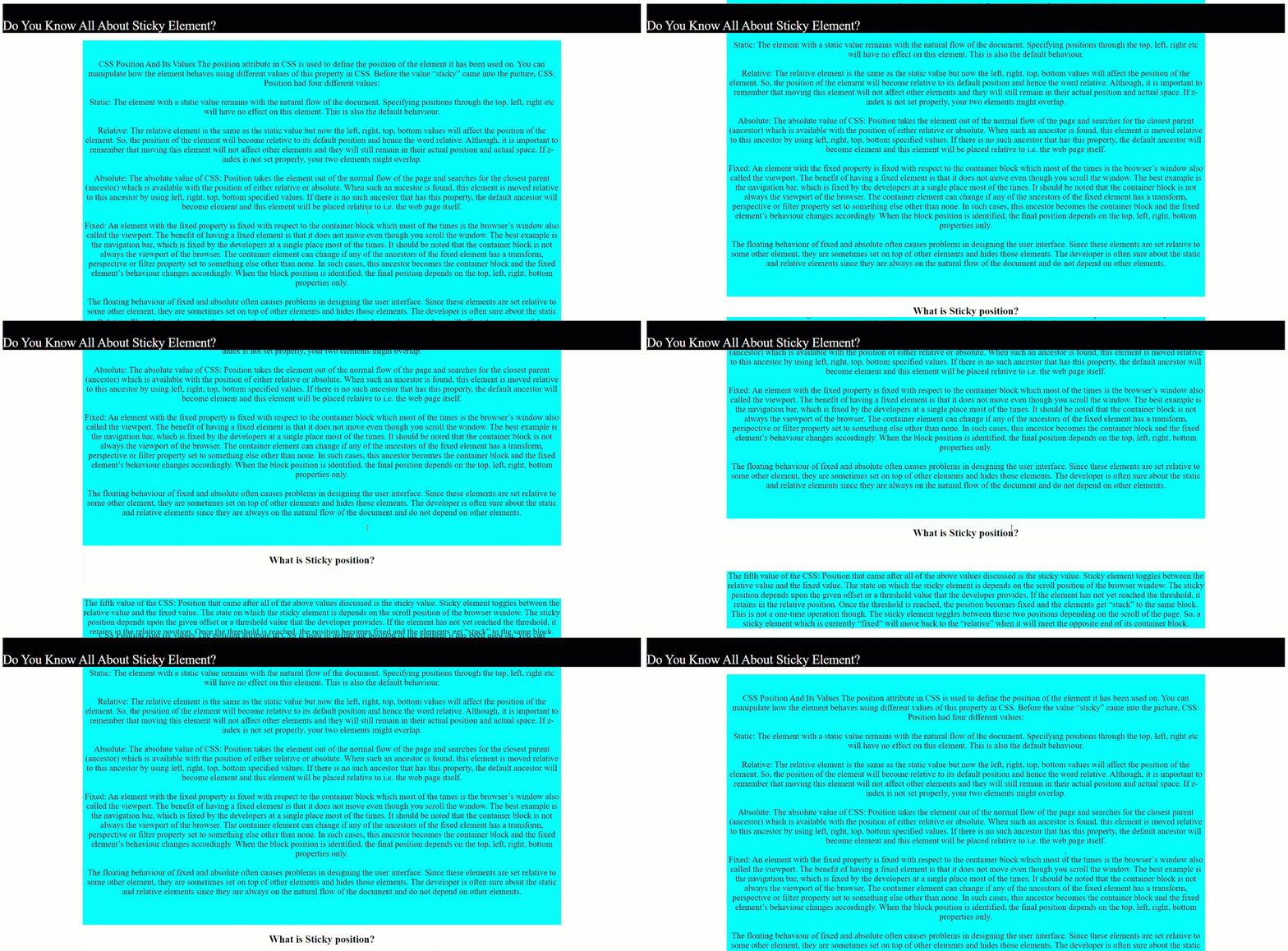
The above GIF contains a CSS position viscous element which is the heading of the certificate: Practice Y'all Know All About Sticky Element? You can see that while I whorl the document, it all the same sticks to the viewport.
How To Create A Position Viscous Element Using CSS?
You need to create position sticky elements to achieve what they call 'CSS position stock-still'. As I have shown you lot higher up, a CSS position glutinous is ever in the website company'south viewport. Creating a position sticky element in CSS as I did to a higher place is very like shooting fish in a barrel. Just you will have to keep two things in mind:
- Declaring the position value as sticky for the chemical element.
- Defining a relative value (besides called the threshold value).
How To Design A CSS Gummy Header?
A sticky header tin can be used to stick the heading of a paragraph to the browser window. So, if the paragraph changes then does information technology'due south heading, a new heading sticks to the browser until the user scrolls the complete paragraph. The following code has been used to create a sticky header:
In the code higher up, I have fabricated the element viscous with the id = "glutinous-div". In the styling part, to make this element sticky, I have given summit:0 because I don't desire whatever gap between the sticky chemical element and viewport boundary.
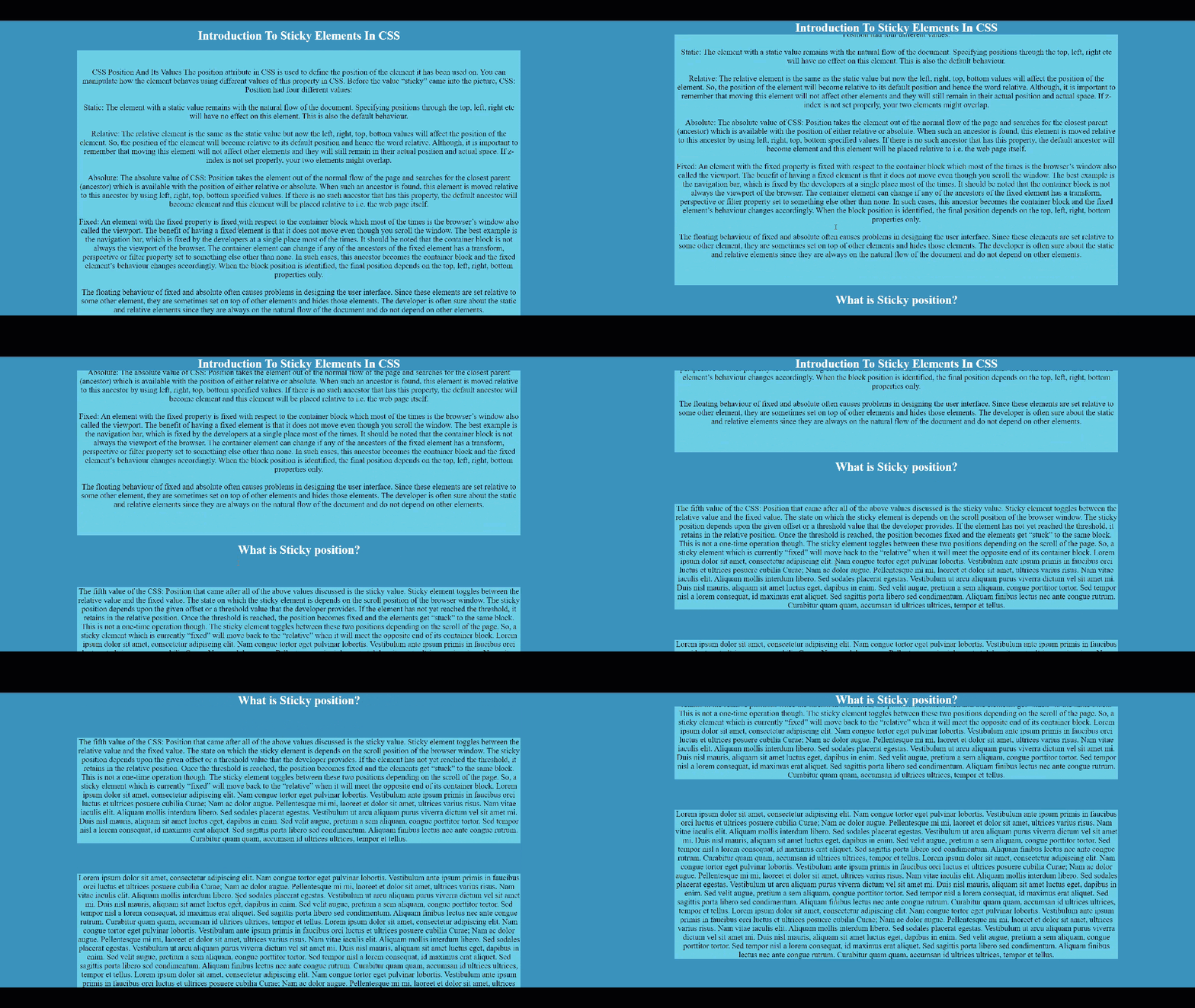
Position: sticky specifies that I need to have this chemical element as sticky. With these two parameters, you can make your chemical element or CSS position gummy in no time. The in a higher place-coded web page looks every bit follows:
How To Blueprint A Sticky Footer In CSS?
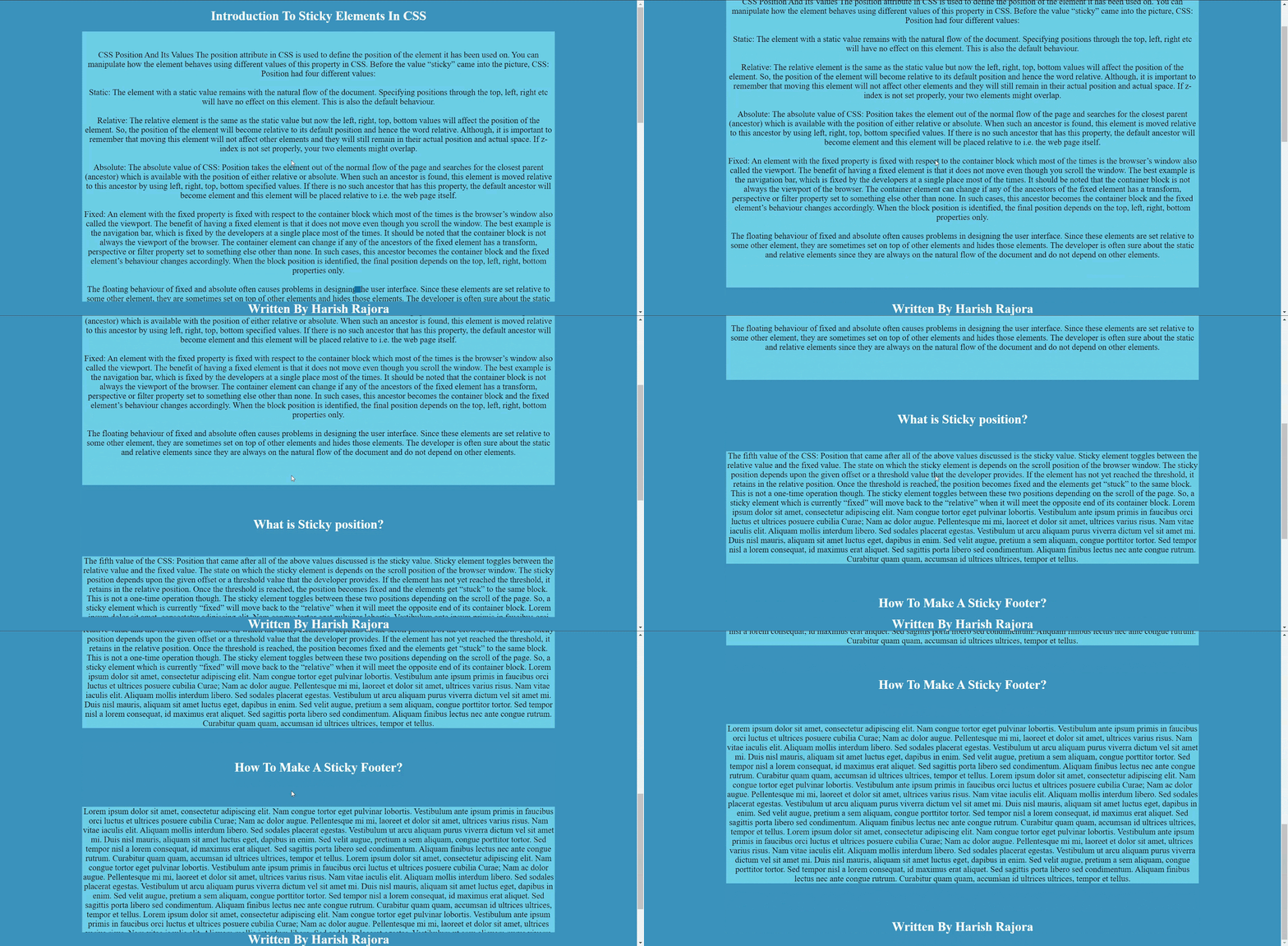
Footer on a website is a great way to catch the middle of the users on something that you want them to see every fourth dimension they load the website and even without scrolling. In the below case, consider an article where I desire the author's proper name to be visible all the fourth dimension. You can employ the same code that we have used higher up with a slight adjustment to make the heading as a footer.
| < style > #sticky-div { position : sticky ; lesser : 0 ; font - size : 30px ; color : white ; groundwork - color : #3991bd; } |
The footer will look equally follows:
How To Design A Sticky Image In CSS?
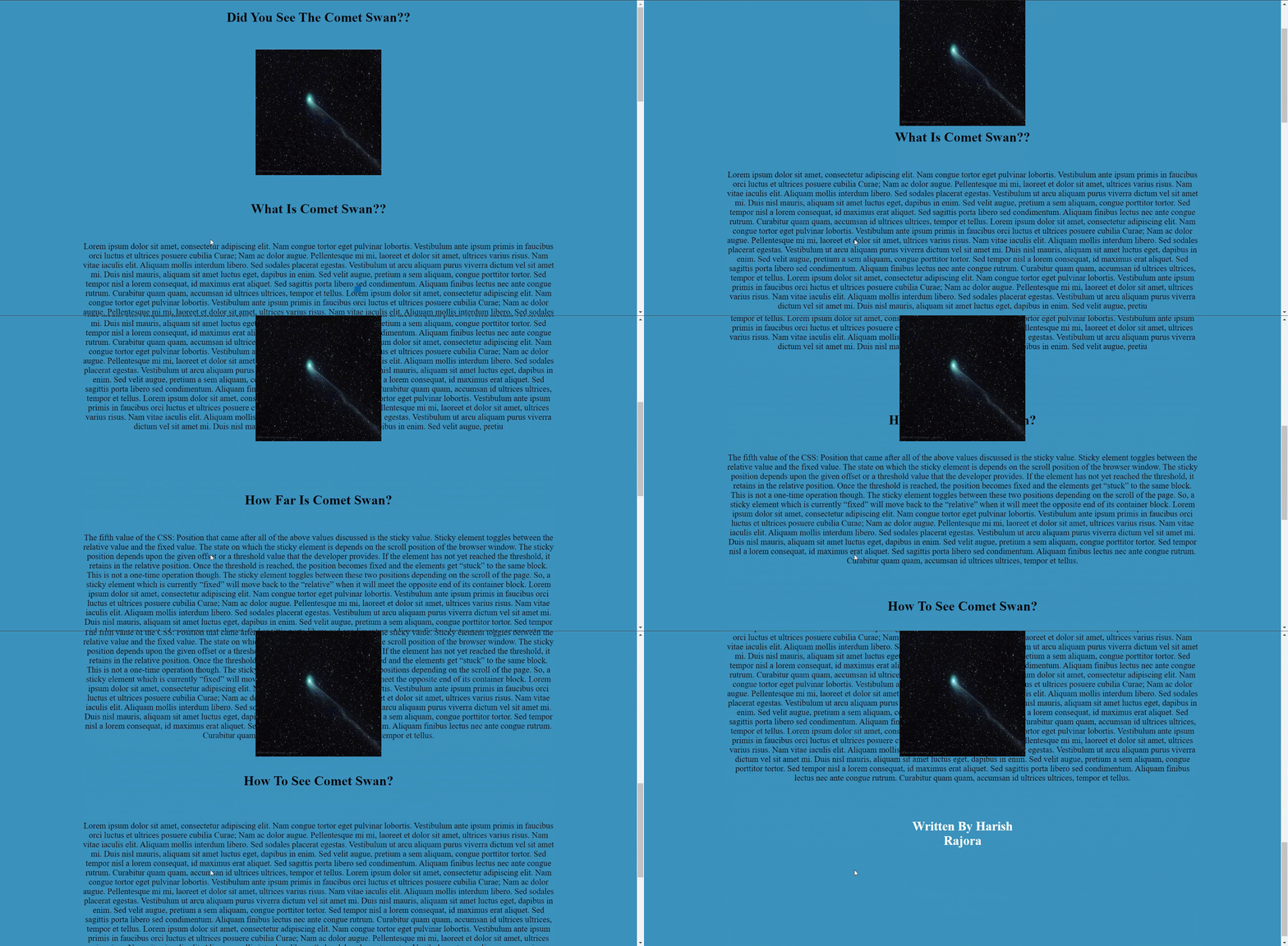
Sometimes, nosotros want to describe something along with an image that is relevant to the description. Simply while scrolling, we lose the paradigm and just the text remains. If the text is describing the image, its meaning or its details, the users might be forced to coil upward and downwardly repeatedly to look at the image and then look at the text. This is annoying for a user and is considered as a bad development do on the programmer's function.
How To Make Responsive Images With CSS, HTML, WordPress & More!
Tin nosotros accommodate something with the CSS position stick to change the user's experience in such situations?
Make the following adjustments in the higher up code:
| <style> #sticky-div { position : sticky ; acme : 0 ; font-size : 30px ; color : white ; background-colour : #3991bd ; width : 150px ; height : 150px ; } </style> |
How To Blueprint A Sticky Navigation Bar In CSS?
Navigation bars are practical on a webpage to ease out the navigation process for the user. Merely, if your folio is too long, and once the user reaches the end, they accept to come back to the top to reach the navigation bar and click the links on it. This is non a smoothen design keeping in heed the user'south perspective. Using our CSS position gluey knowledge, we can create gummy navbars that stick to the screen so that the user won't have to ringlet back to the top.
It will look as follows:
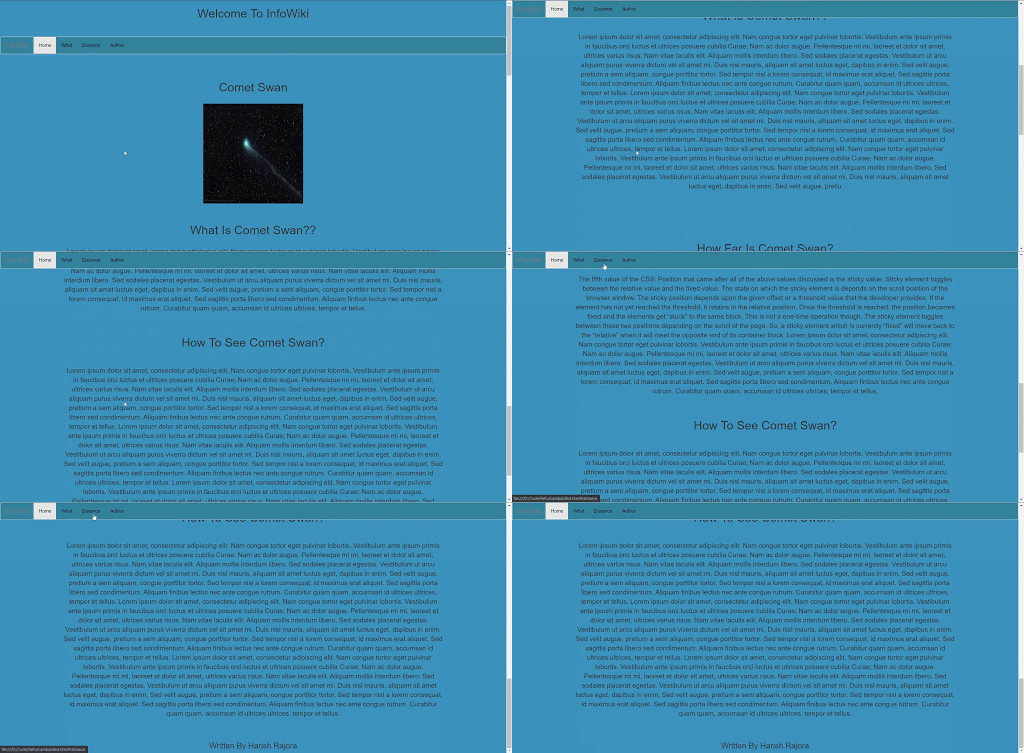
The navbar grade has been made a sticky in the in a higher place code.
Remember that if you are on a Safari browser and so you have to add position: -webkit-sticky along with the lawmaking written above. But, if yet, your CSS sticky chemical element does not work, I am sure y'all might have fallen to the special instance that I have discussed beneath.

Special Case With CSS Position Sticky
While working on a few websites when I discovered the CSS position sticky behavior, I often encountered a hidden problem. The trouble with my position sticky was that even though I specified the position and threshold, sticky won't work!
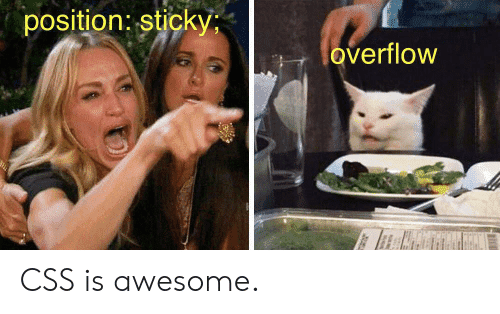
I take seen a lot of developers commit these mistakes (even experienced ones) and the net is filled with such questions. Information technology is absolutely essential to note that if the CSS sticky element has a parent container and that parent has a property overflow: subconscious, then the stickiness won't work. To make the sticky work or to get your CSS position fixed in such cases, you need to either requite some other value to the overflow or remove the overflow property completely.
Precedence In CSS Position Gluey
A quick question might pop-upwards in a web developer's listen about the precedence of the position that the sticky element takes. For case, what if I specify a height threshold every bit well as a bottom one? The element can't stick to both ends, correct? So, how do things work out?
When such cases arise, the CSS viscous follows the precedence rule in society to give preference to one threshold value amongst the specified. The precedence rule is equally follows:
- If the developer has specified both the top and bottom values, top values win.
- If the developer has specified both the left and right values then:
- Left wins if the direction specified is ltr (left to correct).
- Right wins if the direction specified is rtl (right to left).
Direction here refers to the writing direction similar Arabic is rtl (right to left) while English is ltr (left to right). You can visit CSS Writing Modes for cross browser compatibility to learn more virtually that.
Accessibility Bug With CSS Position Sticky
If we remember for 1 second how to get CSS position stock-still and then it would not be too hard to conclude that our browser has to do a lot of piece of work when something is "viscous". When the user scrolls the window, the stock-still or the pasty element has to be repainted onto the screen every fourth dimension. Although it looks equally if the element is stuck onto the window, in reality, the browser has to pigment information technology again and once more with respect to the scenarios (similar different text scrolling behind the headings). If the browser fails in its speed here, and so the chemical element would await a little distorted. The problem here is with people with accessibility concerns like sensitivity issues.
We tin assistance from our side though. To render whatsoever element in its own layer and improve the repaint speed we can add together will-alter : transform forth with the sticky backdrop.
Cross Browser Compatibility For CSS Position Sticky
The current browser support for CSS Position: sticky is really smashing. All the major browsers support position viscous elements except for Net Explorer and Opera Mini.
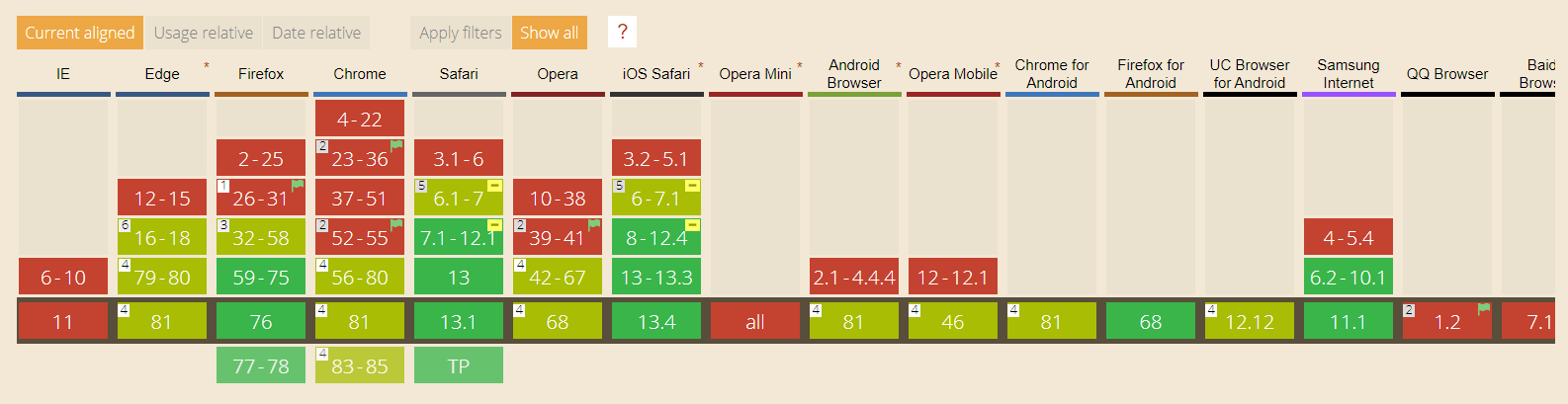
If you notice the higher up image, although currently, all the browsers back up this feature, the support came besides late considering the basic design implementation it provides. For example, Google Chrome supports it from version 56, Firefox from 59, and and so on. This makes the states wonder, how mutual is CSS position mucilaginous on the web?
Read: Cross Browser Compatibility Smooth Scrolling with CSS, JS & JQuery
Why Don't We Apply CSS Position Sticky That Much?
Looking at what CSS viscous has to offering in web evolution, they are used considerably less by the web developers today and I am not counting the big firms or established platforms with defended teams. The CSS sticky came at the right time on the internet simply the browser support or cross browser compatibility for it came too belatedly. Seeing no cross browser compatibility, developers didn't want to use information technology on their websites and projects.
Till the time the major browser rolled out their updates with CSS glutinous back up, it was out of the race. Being in the sand for and so long fabricated developers forget about it. On the other paw, stickiness does sometimes behaves inappropriately equally in the case of overflow holding. Only, on the positive side, stickiness has started to plow upwards on many websites even though the number is also small. Besides, it helps a lot in getting your CSS position fixed. I hope to encounter it proceeds speed in a couple of years.
How To Run CSS Position Sticky On Internet Explorer?
Cyberspace Explorer has never supported the CSS sticky property and it never will since it has been deprecated (the death of IE). Merely, as a spider web developer, I cannot publish my website ignoring the Cyberspace Explorer browser as information technology is still used by many people. To employ the CSS position gluey property, I accept to utilise some turnarounds.
- Negative Margins For Footer : To place the footers on the website, negative margin-top property can exist used:
#footer {
summit : 20px ;
Margin - top : - 50px ;
}
- Flex-box can be used to avert specifying the elevation of the footer every bit in the negative margins. The developer can use the property of the flex-box with different combinations on different container elements to place the element mucilaginous.
- Grid: CSS grids tin can also be used along with the position value fixed to stick it on the viewport.
- JavaScript: You can become ahead with the old javascript methods that were used earlier the introduction of the gluey position.
Conclusion
CSS position glutinous gives us something that the developers have been using for too long but with besides much trouble. Although the gluey property came a long time dorsum, it did not become much appreciation from the browsers. Even if it did assistance in getting the CSS position fixed too. The well-nigh frequently used browser in the world, Google Chrome, provided support for CSS mucilaginous equally late every bit 2017 i.e. 4 years after Safari gave its support. So, if I take Google Chrome as a reference, I detect the CSS position sticky a fairly new property (but from the usage point of view). Seeing this, the web developers have not been using it on their website in the by but, this trend is irresolute now.
The sticky position is taking upwardly stride in the market and with practiced new designs, it is used in very innovative means. CSS position pasty also uses GPU to provide meliorate accessibility for the people who demand it which, in plough, requires a lot of machine power at times. Unfortunately, not everyone has the ability to set up their own GPU'south to use CSS position gummy for cross browser compatibility. Fortunately, LambdaTest does just the aforementioned past letting you perform cross browser compatibility testing over the deject. With LambdaTest, you will be able to create CSS position sticky and test the element's cross browser compatibility over 2000+ browsers and operating systems.
In this post, I accept taken y'all to the depth of CSS sticky with some special cases and concerns. While I wrap this post up here, I would be glad to meet some comments on your feel with the gluey property of CSS positions and how this mail helped yous in getting CSS position fixed.

Written by Harish Rajora
I am a information science engineer. I love to proceed growing as the technological world grows. I feel there is no powerful tool than a computer to change the world in any way.

Source: https://www.lambdatest.com/blog/css-position-sticky-tutorial/
Posted by: stewartlethemstes.blogspot.com
0 Response to "How To Clean The Sticky Feeling Off Of My Rubber Framed Sunglasses?"
Post a Comment